@_awbery_ @QiaochuYuan One thing I found striking is Culadasa's description of enlightenment in terms of the neurology, talking about the brainstem. I'm now super fascinated how this connects with @Meaningness' depiction of the different Results of sutrayana & tantrayana.
Enlightenment models, Culadasa, and hemisphere lateralization
9 tweets · June 2019 · 14 likes · 0 retweets · read on Twitter

@_awbery_ @QiaochuYuan @Meaningness I have posited that all forms of awakeness seem to have something to do with increased right hemisphere activation, but Culadasa's description in the podcast seems different!
@_awbery_ @QiaochuYuan @Meaningness Reading this Theravada quote (see adjacent tweets) it seemed that the subject in question was left-hemisphere attention (although as effectively integrated with right-hemisphere awareness.)
@_awbery_ @QiaochuYuan @Meaningness But then this distinction between LH attention and RH awareness itself comes from... Culadasa! Not sure of original source but this reddit post on /r/streamentry about McGilchrist's brain hemisphere work says Culadasa explicitly connects the two. reddit.com/r/streamentry/…
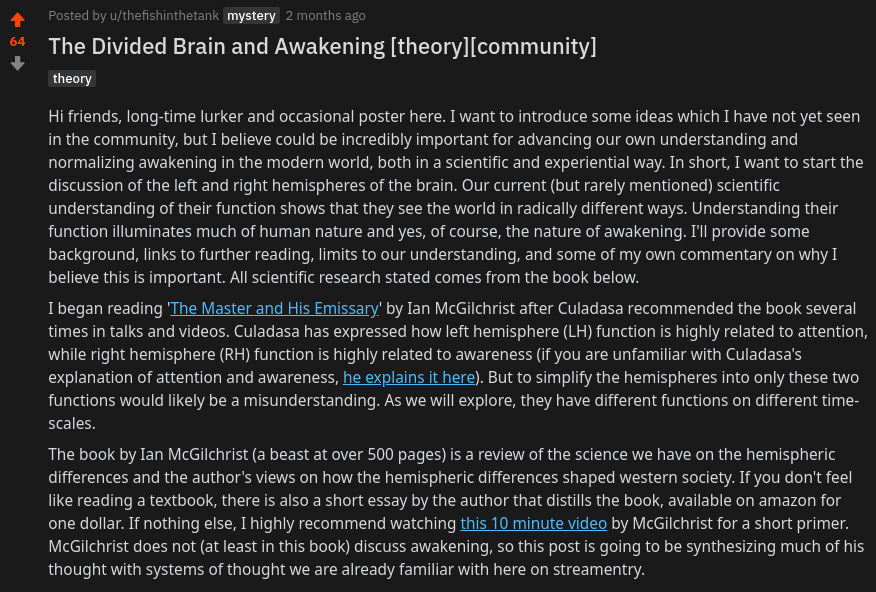
@_awbery_ @QiaochuYuan @Meaningness Meanwhile, tantric/dzogchen "result" as described in Spectrum of Ecstasy seems almost 100% about shifting to a primarily right-hemisphere-based form of consciousness. (Realizing now that this thread 👇 doesn't actually explain the relationship! #todo)

@_awbery_ @QiaochuYuan @Meaningness So! I still have only the foggiest ideas of how these all relate. Would love to hear thoughts from @_awbery_ or @Meaningness on the subject! Or maybe that needs to wait for me to explain how I see the hemispheres as connecting to nonduality.
@_awbery_ @QiaochuYuan @Meaningness Oh! One further thought is that I have a felt sense of a subtle connection between some of the descriptions of renunciate practice in this thread, and the disembodied philosophers of the enlightenment, eg Descartes.
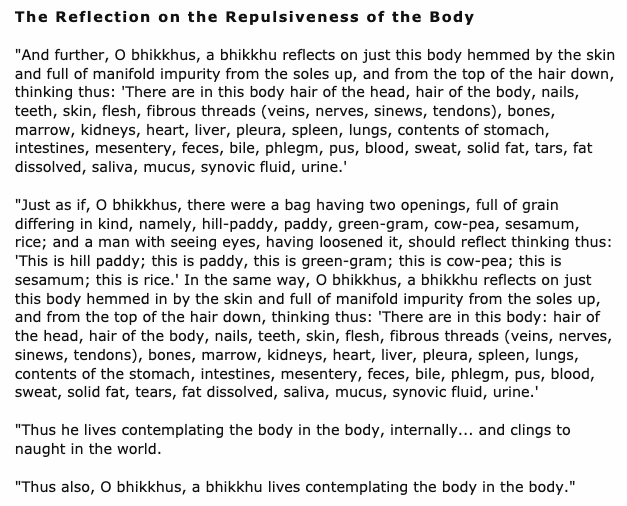
@_awbery_ @QiaochuYuan @Meaningness Sense of "the body is a problem but by breaking it into parts we can reject it thoroughly." Here's Descartes re: the body, from McGilchrist's book, The Master and his Emissary. The screenshots are in two pairs—there's a jump of a few pages between them.

@_awbery_ @QiaochuYuan @Meaningness Now I'm wondering "was Buddhism originally like this, or did it evolve to be?" (Similar to the absurd opulence & authoritarianism of the Catholic church—absurd because it calls itself Christian and Christ seemed quite opposed to such opulence & authoritarianism.)