Have just read the first half of this and it's really cool.
Bergson on intuition, perception, and change as base
10 tweets · July 2019 · 10 likes · 2 retweets · read on Twitter
This insight about the relation of action & perception & categorization is really powerful and connects directly with Iain McGilchrist's model of the brain hemispheres.
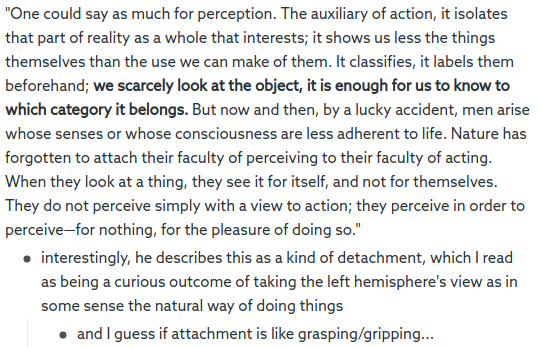
Quote from Plotinus: "All action weakens contemplation." I recently spent a week at the @MonasticAcademy, meditating, emotion-processing, & doing we-space work (eg circling). And one thing I noted was the challenge of having we-spaces that can act to care for the future.
"But suppose that instead of trying to rise above our perception of things we were to plunge into it for the purpose of deepening and widening it."
Both/and philosophy

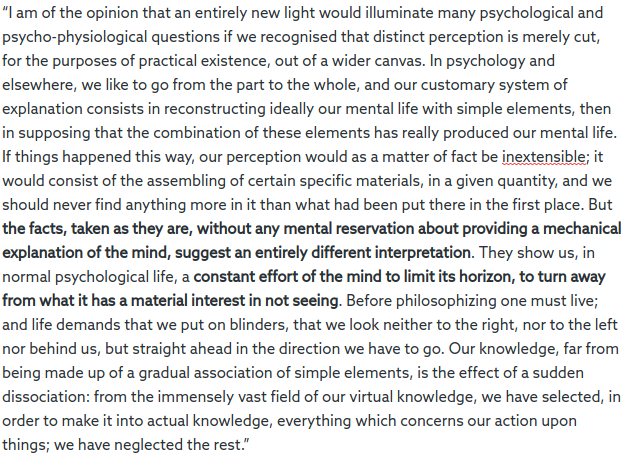
"constant effort of the mind to limit its horizon, to turn away from what it has a material interest in not seeing" McGilchrist highlights that the left hemisphere's world is already narrowed in this way, so any such effort is the effort of the LH to suppress RH's perspective.
Loving how Bergson appreciates so strongly with Kant's demonstration of "metaphysics requires intuition" then disagrees so plainly with Kant's conclusion that "metaphysics is impossible"

And then yes, at last, the reason @infiniturtle shared this with me: a really cool piece about the nature of change & movement and how [the left hemisphere] tries to build it up from fixity, rather than recognizing change as the base aspect.

Huh, in saying "recognizing as base" I'm now thinking about "base, path, result", terms from @Meaningness/Dzogchen. And *then* I'm wondering: is the "recognition of change as base" the same as the "recognition of emptiness" described as base for tantrayana in this table...?
