The term "pre-success failure" from @ScottAdamsSays' book is a gem. His related idea that you should have systems and not have goals is absurd. (have both!) Scott cites Olympic athletes as examples. 🤨 Take 3 guesses what goal an Olympic athlete has... 🥇🥈🥉
Goals vs systems and the trap of pre-success failure
18 tweets · December 2019 · 171 likes · 9 retweets · read on Twitter
Systems don't work without goals. You need a goal in mind in order to choose/design what system to follow, and it's literally impossible to evaluate whether a system is effective without something to compare it with. Implicitly, that's a goal.
We know certain Olympic athletes had good systems because they got the medals. They designed those systems to optimize for their athletic performance. Lots of other Olympic athletes *also* had training systems, but their systems didn't work as well—as measured by their goals.
I'm part of a team that runs a goal-setting workshop each year called the Goal-Crafting Intensive (where part of the craft is setting up systems) and the definition of goal that we use in that context is:
This is a very spacious meaning for "goal". It doesn't require: 📅 a due date (usually embarrassingly over-optimistic) #️⃣ a numerical metric (which is just a proxy for what really matters) 🏁 a state of finality (it has to be in the future, but it can be ongoing)
From this perspective, it's impossible not to have goals, so the real Qs are: 1. do I know what my goals are? what they *aren't*? 2. how am I relating to them? 3. do my explicit goals match what really matters to me? 4. am I actually working towards them or are they just dreams?
And it's in "how am I relating to my goals?" that we get to the topic of "pre-success failure". Scott doesn't actually define the term, but it seems to be roughly "feeling bad that you haven't already achieved your goals" His prescription for avoiding this is "have no goals".
This is a great hack, and one that I've noticed myself and many other people doing, without even realizing it.
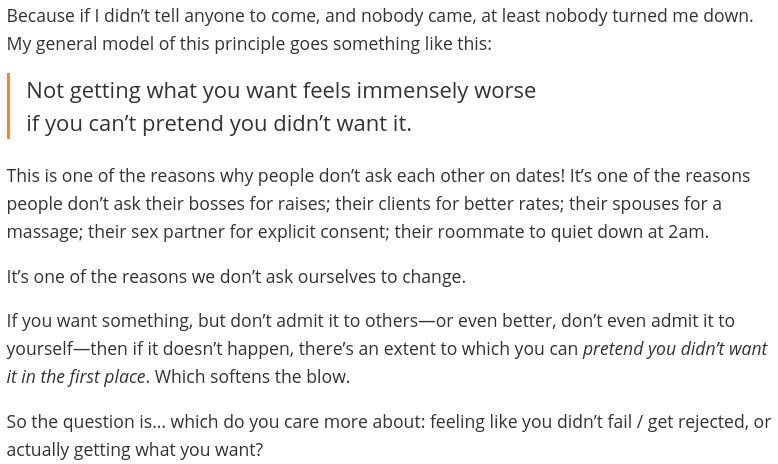
But as long as you operate this way, you'll never get clarity on what you deeply want, which means you're unlikely to ever get it. If you have taste, it's also possible to just follow your nose, but that still can only access adjacent things you want, not things further away.
Is there another way to avoid having pre-success failure? That's a complex question! One is to note that you probably actually do it all the time on smaller scales: when you decide to go get a snack, you don't suddenly get upset that you haven't already gotten the snack.
Another approach: recognize that what you want is already what you want, & that acknowledging you want it & strategizing about how to pursue it doesn't mean that you have to say something's wrong about your current situation.
@ScottAdamsSays "instead of goals, have systems". I say "have both". Most goals aren't achievable without systems, and systems can't be evaluated without comparing them to the goal they're intended to serve. You can't not have goals. Have them *well.*
There are other caveats to note about pursuing goals: #1: You may feel aimless once you've achieved your goal. This is the corollary of pre-success failure—thinking that you'll suddenly feel happy once you've achieved your goal. No reason to assume so!
Caveat #2: Getting fixated: let your goals evolve as you learn more. I do think it's worth at least *once* finishing a goal that no longer seems good, to make sure you're not just averse to finishing, and to learn how to generate enthusiasm: twitter.com/RealtimeAI/sta…
Caveat #3: You may not want to pursue your goals ruthlessly! You may want to pursue them playfully, or sensually, or curiously🤸♀️ That "how" is your values, and they're at least as important as goals. See @edelwax:
Caveat #4: sometimes becoming goal-oriented can create a kind of narrow-minded focus that blocks out awareness of other careabouts, including relationships. I used to think this was a necessary learning phase... now I'm less sure about that! May still be for some people.
In any case, inasmuch as your way of being in relationship is trapping you in shoulds, & you can instead find a way to tap some sense of what *you* really want to do & do that instead... that that's key to developing self-authorship.
Anyway, if you're still with me at the end of this long thread, I bet you'll get a lot out of our Goal-Crafting Intensive online workshop: 🎯 learn more about goal-setting & pre-success failure 🔭 design your year 💬 get guidance from me & other coaches complice.co/event/plan2020…