Great piece by @KevinSimler! It uses simple agent-grids to model the spread of genes (ie infections) and memes (ie ideas/theories) through populations.
Simulating memetic spread and the incentives of academic research
11 tweets · May 2019 · 24 likes · 2 retweets · read on Twitter
It's a great demonstration of the nonlinear effects of simple parameters (transmission rate). Below a certain threshold, an infection consistently dies out. Above, it spreads. Most people profoundly don't appreciate how many things in the world are like this.
What small changes produce huge compounding results? I was inspired to come back to twitter 2 years ago based on realizing that by just being a bit more public with my ideas, I could build a ton of relationships.

I would love to see @KevinSimler or @ncasenmare or someone else develop some more simulations of nonlinear or complex system dynamics, to give people better intuitions for these.
I want to highlight something specific about memetic model in Kevin's essay, which is talking about the importance of academia. He describes a tension between academia providing valuable networks but bad incentives. Then has a simulation demonstrating negative fx of careerists.
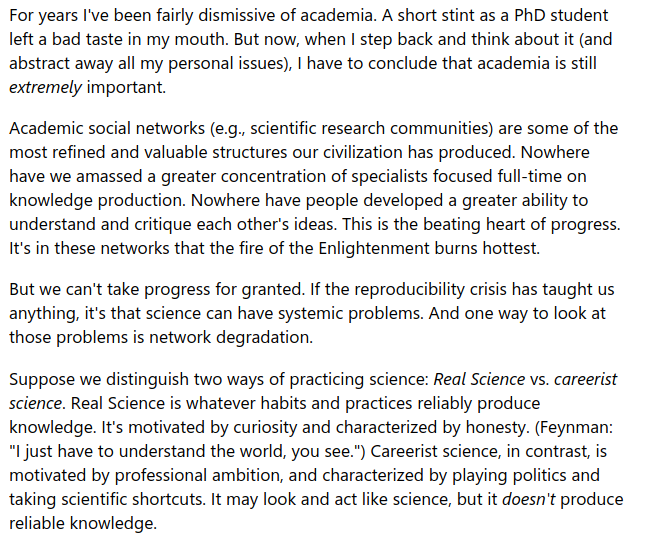
I read this mini-ebook a few days ago that suggests that the incentives of academia are actually so bad that nearly everyone ends up functioning as a careerist scientist, not a real scientist. I don't agree with everything in this essay, but it got me 🤔 thestoryofscience.blogspot.com
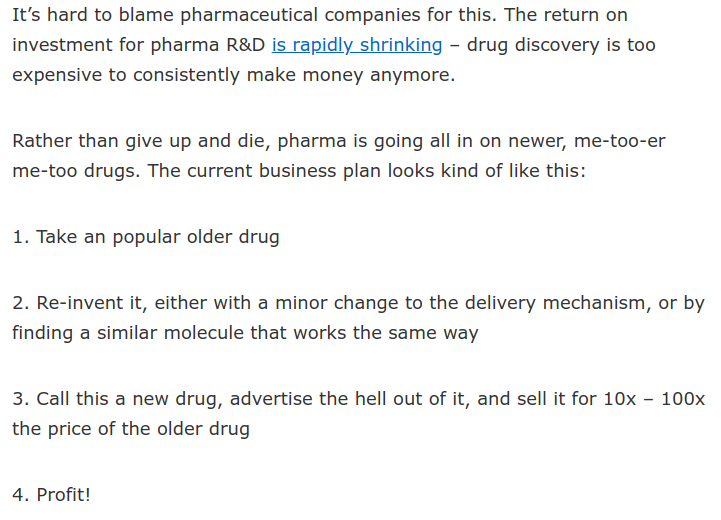
(The conclusion of the link above is that basically almost no real science is happening anymore, which honestly resonates a lot with @slatestarcodex's depiction of drug research. I guess that's industry, not academia?? Still, FDA busted incentives.) slatestarcodex.com/2019/05/22/the…
So my steelman of what Kevin is saying is that having networks of people researching is extremely important. And I think that it would be pretty fascinating to use some similar simulations with a dozen more parameters, to investigate what would make those networks optimal.
How does "publish or perish" look in a simulation? How does p-hacking show up? What about file drawer (nonpublication) effect? What role do peer-review/gatekept journals play? What other factors are there that cause some theories to spread more than others?
Now I'm thinking that some stuff from @DavidDeutschOxf's work on memes, criticism & culture could be inspirational for designing alternative research communities...
When I think about research communities/networks, I also imagine some incredible possibilities with platforms like twitter or something @Conaw might build, as being contexts for people to notice connections between theories they're working on & build together.