this is basically most of theology
Trust versus faith in the unbreakable plate trick
12 tweets · April 2026 · 104 likes · 2 retweets · read on Twitter
so there's a whole dance here of trust and faith [SPOILERS] the son has a neat plan but he can't quite keep it straight. he confuses his desire to trick his father with his desire to have his father trust him, but this trick is *not* a con(fidence game). it relies on the distrust
so he makes a plea "just believe me". which could mean "just trust me bro" (always sus) ...the father *wants* to take his son's word for it! wants to be able to. but if he trusts the son's word as implying the plate is unbreakable, then he has no need to save the plate himself.
"just believe me" can also be "just have faith", which is a more reasonable thing to say, but by default doesn't produce a strong enough faith instead, a kind of vague but shaky faith that something will save the plate, but not one that inspires him to *be* that something
if you want to play this trick well, you need to do one of two things: 1. be sufficiently *suspicious* that he absolutely does not trust you, has no reason to trust you, thinks he will look foolish if he trusts you. then he'll snatch the plate to prove (to himself? to an imaginary onlooker? to you?) that he isn't a fool (gullible)... thereby proving himself a different kind of fool you need to be MORE suspicious, maybe while also making fun of his suspicion. make him not want to find out what would happen if he didn't catch it.
2. *alternatively*, you need to give him a profound unshakeable faith that the plate shall be saved—that it is ordinary porcelain, and yet it will survive the throw. with subliminal hints that it doesn't hit the ground but overtly still projecting that it will? anyway, play this *just* right and either the father realizes at the last possible second that he's the one who needs to save it, which is as much a koan as a trick.. or he doesn't realize he will prove the son right but like, psychocybernetically his mind IS actually working to solve "don't have plate break" and thus he reaches out to grab it while consciously he's like "son is a fool". this is tougher than the sus version; I bet I could do it like 1 in 10 times at best, *after* practice. good mentalists maybe 1/3, 1/5? idk.
not sure exactly what the moral of this is wrt trust and faith, but it's sure interesting faith in general deals in matters of hyperstitioning—it works because you believe in it; the sus version of this trick is ~anti-hyperstitioning; it works because you don't.
somehow this whole thing feels like the parable of the drowning man, but more complicated
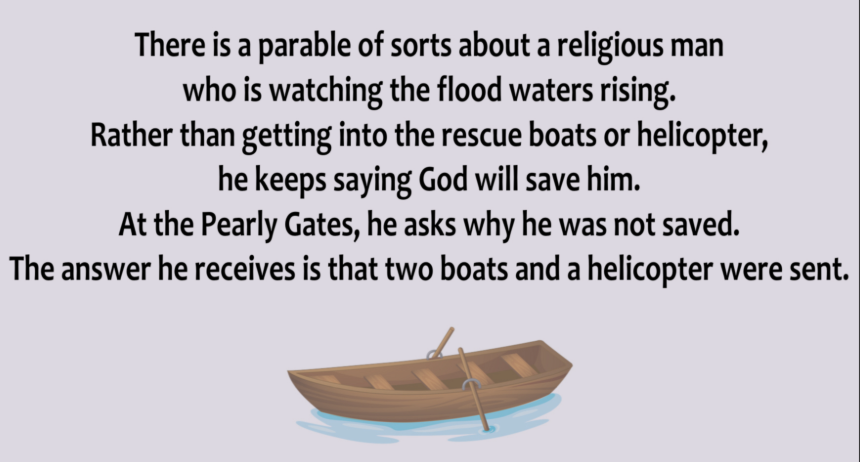
can I say what I mean slightly more re this being most of theology? to some extent I just mean "there's a lot of muddle about what is supposed to be the object of trust or faith, in addition to muddle between the two of those"
but like, in the theology thing here, is God the kid or the dad? in the drowning man parable analogy, God is the kid, failing to communicate the appropriate use of faith, and the man is the dad, attempting to be devoted but not seeing he has a part to play
is there a reverse version? I sort of feel like somehow there is. we are the kid, composing faith tests for God to pass, and failing to understand the system dynamics by which faith attractors work—that make this a bad way to build faith. then we lose faith! unnecessarily!
anyway, the only *unarguably foolish* thing the dad did was sweep up the broken dish at the end. that kid is plenty old enough to do that himself, and had no reason to be saved from those particular consequences.