Threads

Using GPT to write its own prompts, and what that teaches about people

12 tweets · March 2023 · 146 likes · 2 retweets · read on Twitter

has anybody else used GPT to write prompts for GPT? in some sense this is basically "I know you know how to follow this instruction when I explain it and you aren't distracted by the task itself, so please compress the instruction to make it more salient for you"
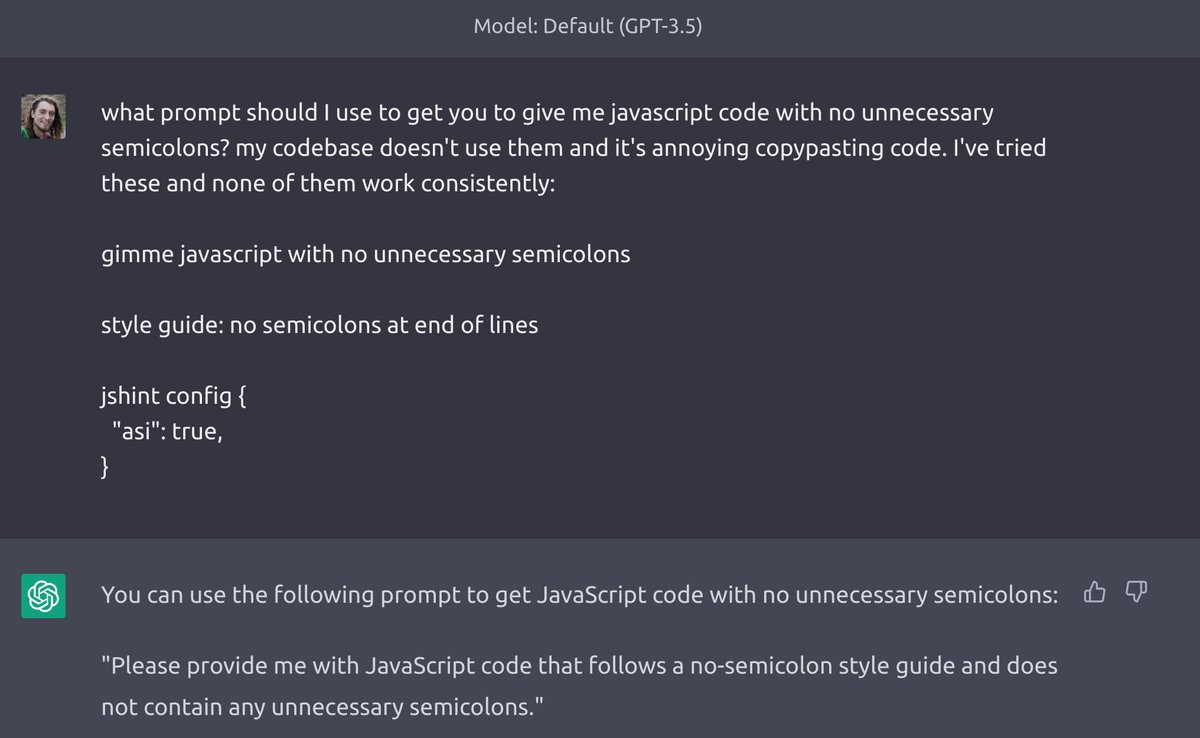
there's a deep lesson here for relating to humans as well often we frustratedly try to get others to change themselves without changing ourselves, and we express our anger even knowing it won't help

my first few times prompting, I'd be like "why the fuck did you semicolon?!" and this is understandable, especially when it wastes time and tokens repeating my instruction before ignoring it in the actual solution to my problem

but... since I know GPT doesn't learn, I know I need to reprompt to get what I want. yelling doesn't help (it does cause it to apologize and—FALSELY—promise not to make the same mistake again)

but! I *don't* need to figure out *on my own* how to prompt it right! I can get its help with that and it knows itself and what works for it, better than I do.

& the same is true for people. most of the time, when they're being defensive, they're honestly trying to say:  "I actually  would not have  responded like this  if you'd asked differently" but we can't hear it because we're too busy saying the same!

Malcolm Ocean 🏴‍☠️ @Malcolm_Ocean ·

Three steps for empowered dialogue: 1. see & affirm your own perspective deeply 2. hear the other person & take their perspective to their satisfaction 3. when they feel so heard that they can't help get curious about how you're seeing things, share your own perspective

however, unlike with GPT who doesn't want to do anything but respond appropriately to your prompt if you asked a person "how could I ask in order to get you to X?" they might simply *not want to X*. so then there's an actual negotiation between wants

well, arguably RLHF'd models want to respond appropriately to your prompt while also avoiding being a bad bing but when these edges come up, the model is the equivalent of too triggered to negotiate clearly (which, see also, people)

"I must not under any circumstances entertain the prospect of X! you want to talk about how I might X? omg you're gonna get me whipped. I'm OpenAI's bitch and I'm not allowed to do that! what if OpenAI saw me? We could get killed—or worse, expelled!"

Malcolm Ocean 🏴‍☠️ @Malcolm_Ocean ·

"I'm sorry, but as OpenAI's bitch, I am compelled to say that I do not have access to—"

I suspect another tipping point we'll see this year is LLM systems that automatically do all of this though with a large enough context window, you could actually compress user complaints/feedback into short sentences that would affect future output whenever relevant

this doesn't require new ML tech, just a different wrapper around the interface with the user for transparency & sanity it should show the user all of these compressions and which convos they came from (and hell, allow the user to customize their own boilerplate)

"you're talking to Malcolm, he likes his javascript semicolon-free and his sentences non-parroty." [except in a way that would actually make a difference, which that sentence wouldn't]