Threads

Line-by-line feedback on a diagrammatic notation explainer

14 tweets · June 2020 · 13 likes · 0 retweets · read on Twitter

Replying to Adele Dewey-Lopez @AdeleDeweyLopez ·

visual linear logic!! (a work in progress) adelelopez.com/visual-linear-… i tried to write this without assuming any math knowledge, and it has a picture for almost every paragraph, so don't be afraid! if any experts can help me out with the issues mentioned, i'd really appreciate it

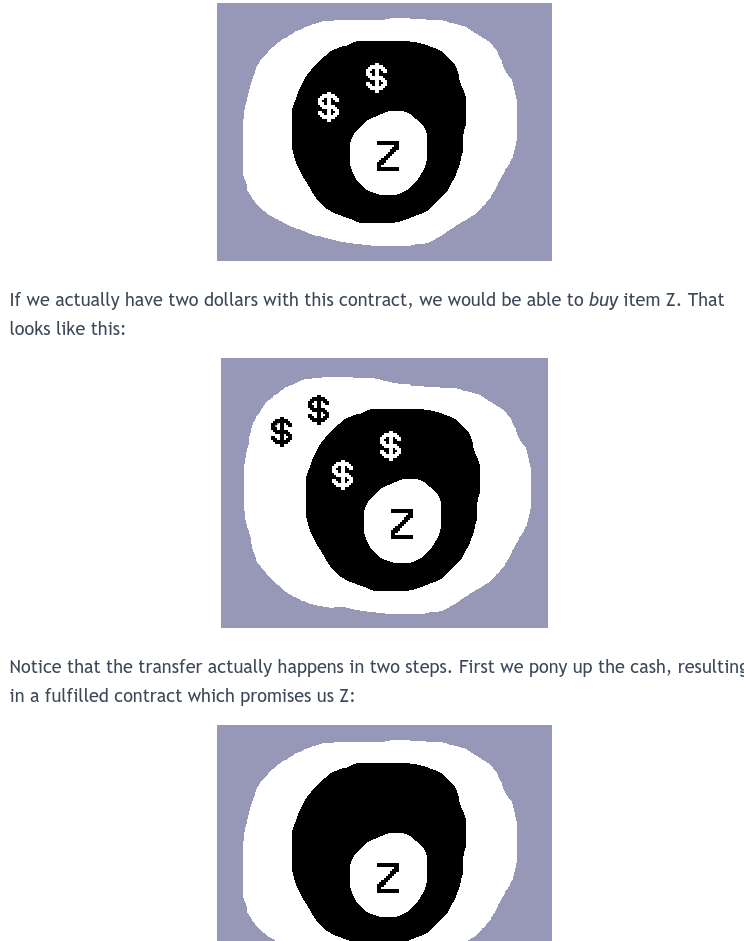
@AdeleDeweyLopez Huh, as a non-expert but mathy person I felt lost on like diagram 2, as I didn't understand [A:= "have" multiple things] and whether those things had any relation. I just kept reading and eventually understood. I think whole thing would be better without diagram 2 at all
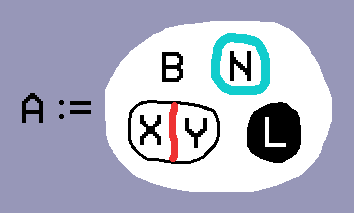
@AdeleDeweyLopez (There may be a way to salvage diagram 2 but right now visually you've actually introduced like 5 new things and none of them are relevant. You said "A in white bubble = have(A)" but now A is outside the bubble, and there are many things in the bubble, and there's a := etc)

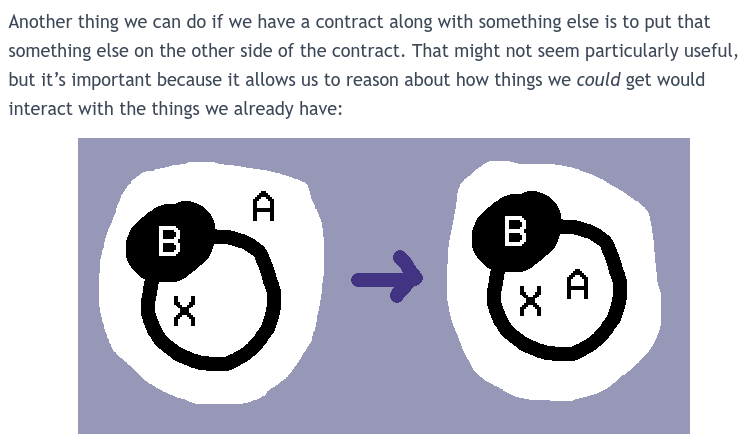
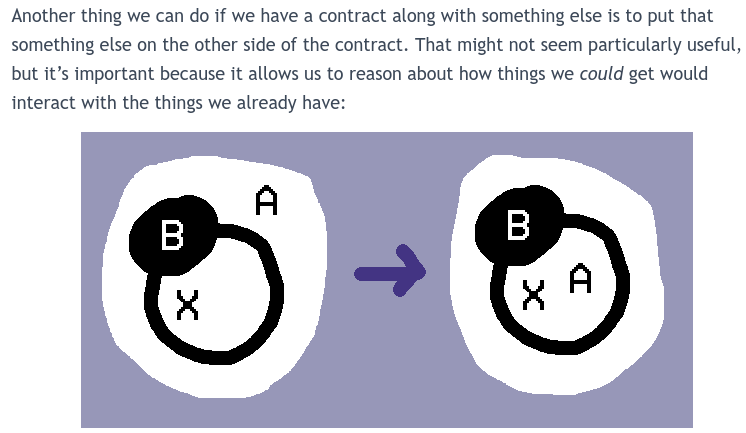
@AdeleDeweyLopez After that, was doing pretty well for a fair bit. I think this section would do well to explicitly point out that given the diagram on the left, moving X *outside* is NOT a legal move.

@AdeleDeweyLopez oh, and this sequences *implies* that it's a legal move to cancel a white-on-black X out using a black-on-white X for any X *outside* the other one... ...but it doesn't explicitly state that. Probably worth doing so. Nice use of $ to make contract intuitive tho!

@AdeleDeweyLopez I would put this section later, which I think is hinted at by the fact that you have to tell us why it's useful before it's actually useful. Introduce it once it becomes useful.

@AdeleDeweyLopez This is beautiful. So beautiful. Not all tautologies are useful & beautiful, but the ones that are useful & beautiful are.

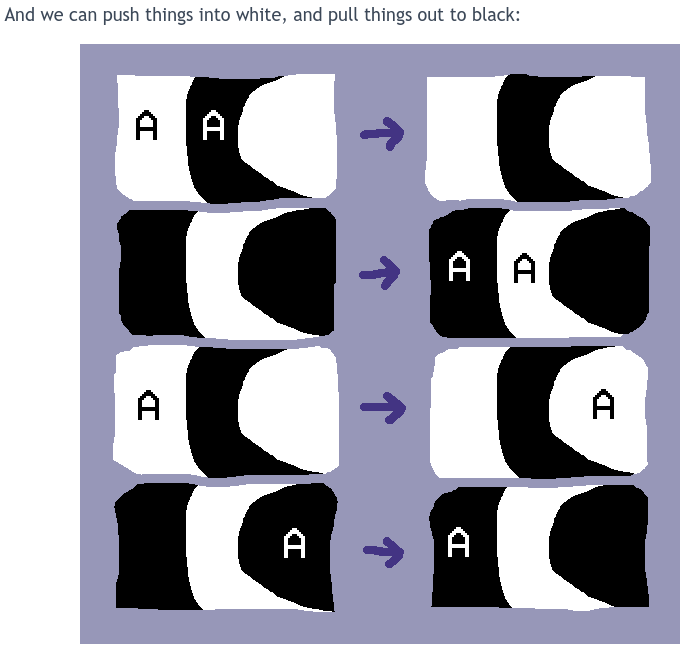
@AdeleDeweyLopez Didn't get this section the first time, but I think I sort of get it now? Issue with black bubble with nothing in it is that it collapses, leaving less-than-nothing—not even havingness-space. Although I sorta have no reason to assume yet that I can't eg wrap it in a white loop?

@AdeleDeweyLopez Okay, then this makes a little more sense than it did first run... it's like, if you had an A, then it would cancel out—wait, could? or would? could I choose not to cancel it? and moreover, how could I have A if there's no havingness space? now I'm confused again

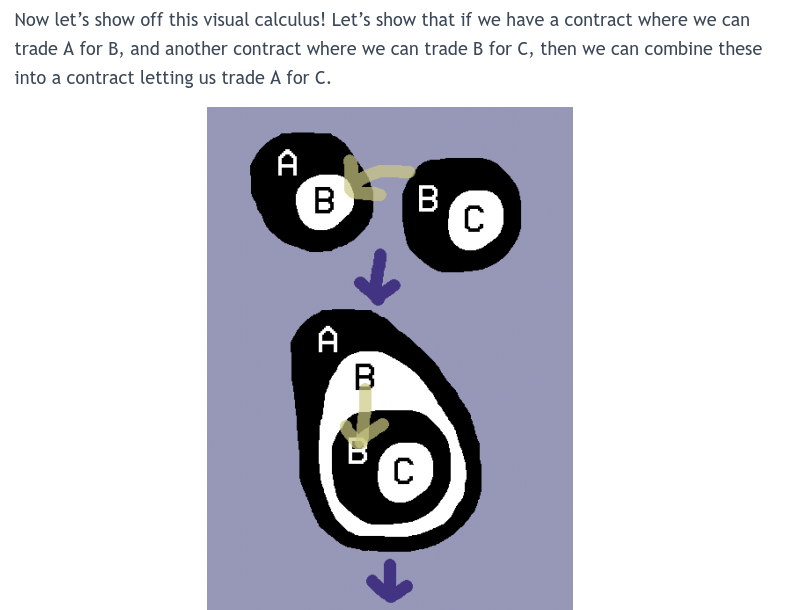
@AdeleDeweyLopez Didn't initially realize this was a new scenario from the previous. Probably would helpful to switch from ABC to XYZ instead of ABC to ABX. Tiny thing but yeah.

@AdeleDeweyLopez I think this would be great with natural language explanations of each, above tautology. ~ 1. A fulfills a need for A 2. if I fulfill a demand for A, I will have A (the loan) 3. if I have A, I'll still have A if I fulfill this contract 4. if I need A in the future, could need now

@AdeleDeweyLopez this is great. loving the simple use of different colored arrows for "move" and "becomes"

@AdeleDeweyLopez uhhh I was vaguely confused when I first saw the red here, because... I was like "Wait does red go with white and cyan with black?" but then I looked above and I was like "oh no that's a totally separate thing" definitely could use metaphoric example here

@AdeleDeweyLopez okay... so something like the difference between an "OR" and an "AND", but not just like how (AB) means "I have A and B" but actually like "there are distinct conditions and I must... make them the same... somehow? 😬 still very confused on this one

@AdeleDeweyLopez this diagram seems like it should have an A on the right side