Hot niche take: Kegan's stages are universal only because everyone is universally afflicted with a dysfunction related to left hemisphere fixation. In a culture where this wasn't so, there would still be developmental stages, but they'd be nearly unrecognizable as Kegan stages.
Kegan's stages as an artifact of left-hemisphere fixation
13 tweets · April 2020 · 203 likes · 11 retweets · read on Twitter
The left hemisphere maintains a worldview that it thinks is consistent and perfect, always. That's its main job: to treat the world as something it understands and can manipulate. It denies the contradictions inherent to its map, whatever they are.
The right hemisphere, by contrast, cares more about seeing things as they are than having a perfect model where all of the parts fit together and there's a right answer. But we actively stunt this kind of thinking with modern culture & education.
As people develop more sophisticated ways of making sense of the world, whether via rationality or new age stuff, they end up with some sort of system that they interpret everything through, stored in their left hemisphere. This mostly runs their meaning-making show.
Kegan 1 is before LH takes over Kegan 2 is pre-ethical LH: I control the world to meet my needs Kegan 3 subjects that to external ethical system Kegan 4 learns to construct own internal system Kegan 5 stops trying to do things with a single consistent system, so must be RH-based.
My model clears up a common confusion with Kegan's model, which is "don't kids feel empathy? it clearly can't take until Kegan 3 to feel empathy." Of course not. But if LH has taken over, it takes a bunch of development to hack together simulated empathy.
So in a fluid-mode world like @Meaningness describes where ppl don't grow up fixated in LHem, there'd still be a development process of grasping ever more complex systems... ...but they'd be able to fluidly play with whatever level they *can* grasp!
Open Q: in this fluid world, would there still be discernable stages that map onto Kegan's stages? I don't have a good guess either way on this, but I have an intuition that any model whose stages naturally map onto Kegan's likely has a similar issue. This is many models: 😂
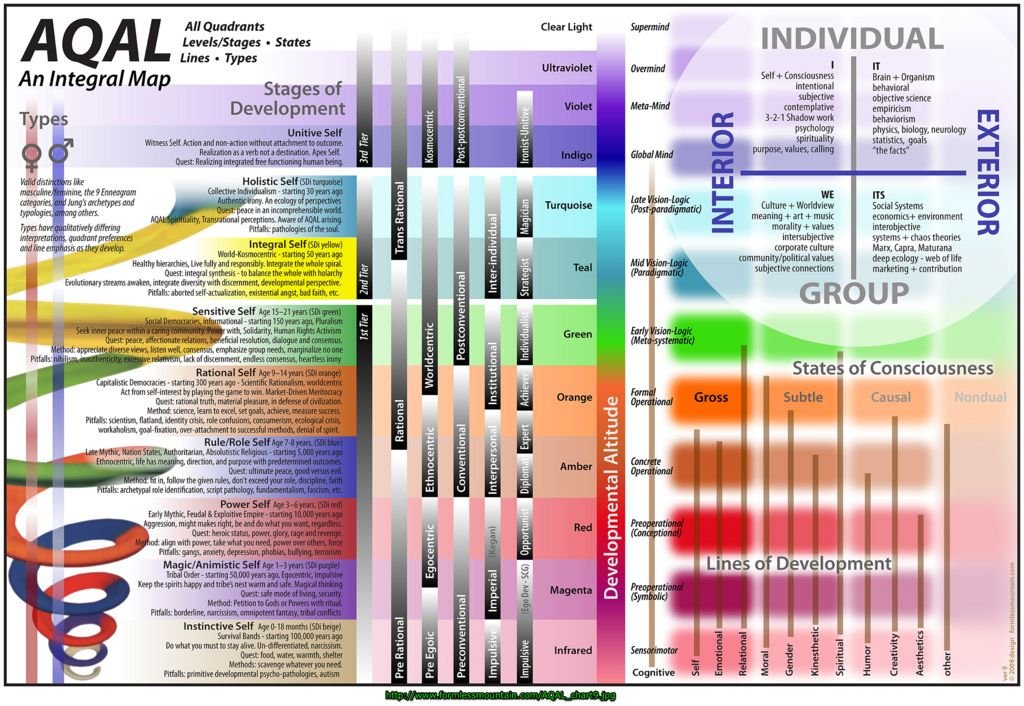
My current best candidate for a model to track the part of Kegan that isn't thusly confused is the Model of Hierarchical Complexity Separates out the "how complex are the cognitive primitives you can manipulate" from cultural stuff. @HFreinacht's intro: metamoderna.org/what-is-the-mh…
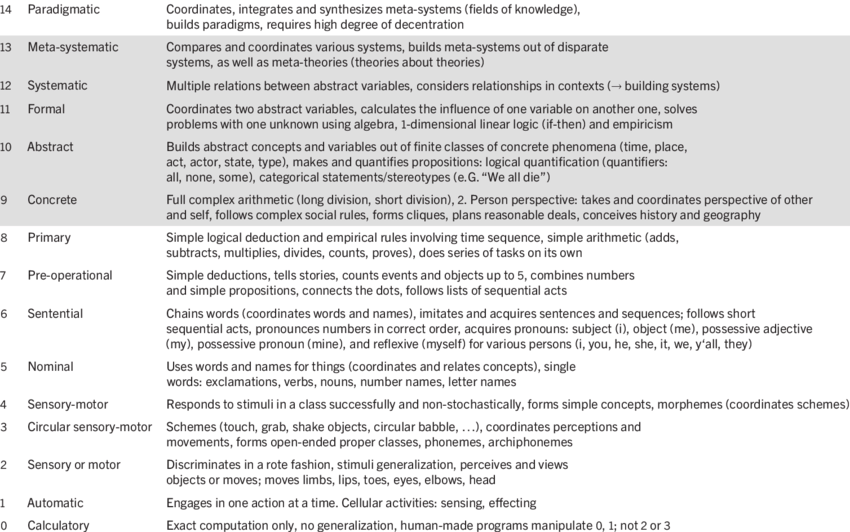
Then the Q: "what specific primitives are you using?" This isn't just qualitative. Some primitives of equal complexity are more powerful than others. Kids readily take to Systems Thinking, a metaframework that outclasses most ethical systems 🕸️
One model of what's going on with subject-object shifts in the Kegan sense (& also MHC upleveling) is that it's when the left hemisphere is able to grasp X as primitive, rather than it being at the paradox level. This could imply the RH is always one stage up from the LH...
...but if I had to guess I'd say there's actually a bunch of other learning for the RH to do, that either doesn't look like developmental stages, or is a completely different axis of dev stages. It's hard to put my finger on what it is though.
Anyway! I feel pretty satisfied with this Kegan+McGilchrist model (which I've had a rough version of for over a year) & this articulation of it. & I'm sure it's got gaps & tangles, and maybe an inconsistency somewhere. In any case, I'd love to hear what you think of it! 💬 ⬇️