@SarahAMcManus @utotranslucence @skybrian Yeah! I was grappling with exactly this challenge a couple of years ago and was also curious about lojban at this time, so looked there for some inspiration. Found a bit but nothing conclusive, and in any case one ultimately needs to port it to English.
Searching for English words that point at groupness
18 tweets · May 2019 · 14 likes · 0 retweets · read on Twitter
@SarahAMcManus @utotranslucence @skybrian What does English already have? Well, it's got the words "each" and "all". Since I was looking for "we" words (not "you") I thought about using "weach" and "wyall" but these seemed cumbersome plus they don't scale because "y'all" is already a thing and doesn't disambiguate.
@SarahAMcManus @utotranslucence @skybrian English also does have something helpful, which is the difference between "(our|your|them)selves" and "each other"! Both essentially reflexive pronouns, but one indicates individual and the other reciprocal. "wash yourselves" is very different from "wash each other" ("go f—"🤣)
@SarahAMcManus @utotranslucence @skybrian However, this still doesn't answer the puzzle of how to point at the whole. "We like ourselves" "We like each other" "We like [us]"? 🤔 You can kind of use "us" but it's meh. Then I was inspired by a parent who shared her ~2yo's phrase "ourchothers". It's an intertwingled mix!
@SarahAMcManus @utotranslucence @skybrian However, this is just a reflexive pronoun. It doesn't actually work in most situations. So while it's cute (and many kids/people have derived it) and Sarah & I use it to talk about ourchothers... ...it doesn't answer the fundamental question of how to point at groupness.
@SarahAMcManus @utotranslucence @skybrian Okay, back to the drawing board. Part of my original inspiration was thinking about the prefix "co-", which seems to effectively point at this... usually. "We're thinking" vs "We're co-thinking" "They're authors" vs "They're co-authors" ...yet "coworking spaces" are solo.
@SarahAMcManus @utotranslucence Despite a few exceptions, this works remarkably well in a lot of situations, both verbs and noun roles! And has resulted in the coining of some new terms, like "cosleep", which means "sleep together, in the literal/boring sense". (If you try to corrupt this, 🖕)
@SarahAMcManus @utotranslucence So we've got "co-" (which in Latin also had "com-", "con-", "col-", & "cor-", depending on the next letter, though only "co-" is still "forming" in pedantic English.) etymonline.com/word/com- & "co-" is great! It lets us form some new verbs & nouns to talk about collectivity.
@SarahAMcManus @utotranslucence And yet, like @utotranslucence, I find myself still dissatisfied, because am I really going to say things like this...? "We need to cothink about where to cotravel on our coholiday"
@SarahAMcManus @utotranslucence (Not to mention the ambiguity of inclusive & exclusive "we" there. As a kid, I was regularly told "we want to go for a hike" and I complained "not fair! the 'we' that wants and the 'we' that hikes are different!" I guess I've been thinking about pronoun ambiguity for awhile...)
@SarahAMcManus @utotranslucence So all of this brings us to Lojban. Which, of course, has thought a bit about this. This page describes how lojban essentially has some extra-fancy articles that let you distinguish masses & groups-of-individuals. lojban.github.io/cll/6/3/ (third image not relevant to this thread)
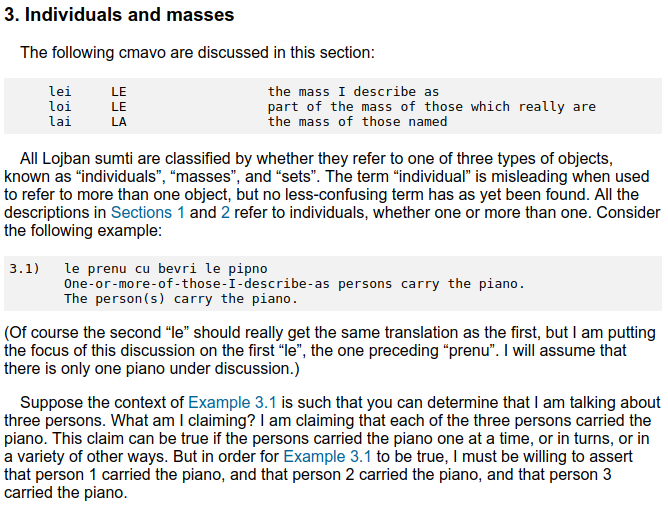
@SarahAMcManus @utotranslucence They also distinguish between masses & sets (lojban.github.io/cll/6/4/) where a mass inherits properties from its individuals whereas the properties of a set refer to things like its count or its membership. This is vaguely relevant and interesting, but not particularly helpful.
@SarahAMcManus @utotranslucence This page on plurals is hard to read but is getting closer to what we're looking for. It distinguishes between different joiner words that have different effects. "joi" creates a mass whereas "ce" creates a set. Okay, that seems about right! mw.lojban.org/papri/plurals
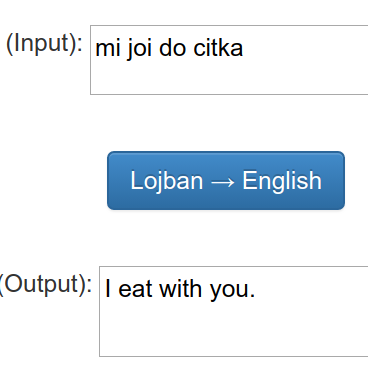
@SarahAMcManus @utotranslucence This page lays out a ton of this in more detail, including another joiner (ce'o) that makes an ordered list, and one ("jo'u") that means "considered jointly" which is probably more of what @utotranslucence is looking for in her article about relationship lojban.github.io/cll/14/14/

@SarahAMcManus @utotranslucence But afaict (#Lojban twitter / @raelifin feel free to correct me on this!) Lojban didn't take the obvious-to-me step of actually turning all of these lovely distinctions (individual, mass, set, joint) into standard pronouns! Not that it would directly help English if they had!
@SarahAMcManus @utotranslucence @raelifin So... twas delightful to get this chance to write all of this up and think through it a bit more than I did originally 2y ago, but I don't actually have any answers for you! I'm a strong believer in neologizing though, so I encourage you to write the article with some new words!
@SarahAMcManus @utotranslucence @raelifin And let the writing process interplay with the word-making process. Use some placeholder words. Once you're sick of them, change them. Notice what distinctions you want to be able to make, and make them. Read the article out loud (& share it with me!) to feel into the words more.
@SarahAMcManus @utotranslucence @raelifin Ultimately there's a ton of distinctions that *can* be made and most of them aren't that important. @fortelabs once posited "there is no such thing as "group knowledge"" and I responded with 8 such things. But they don't all need their own word.