> On the whole, you could say that if you are defending your opinions, you are not serious. — David Bohm (page 48 of On Dialogue) This quote, I think, completely upends classic notions of what sincere, reality-oriented conversation looks like.
Bohm on dialogue: defending your opinions means you're not serious
10 tweets · July 2020 · 48 likes · 2 retweets · read on Twitter
In case it's not clear, he doesn't mean "serious" in the sense of non-humorous. he means something more like "real" in the sense of "come on, let's get real". He means the opposite of what it would mean for an actor to not drop their role when cast goes for beer after the show.
> As long as we have this defensive attitude – blocking and holding assumptions, sticking to them and saying, “I’ve got to be right,” and that sort of thing – then intelligence is very limited, because intelligence requires that you don’t defend an assumption. (On Dialogue, p40)
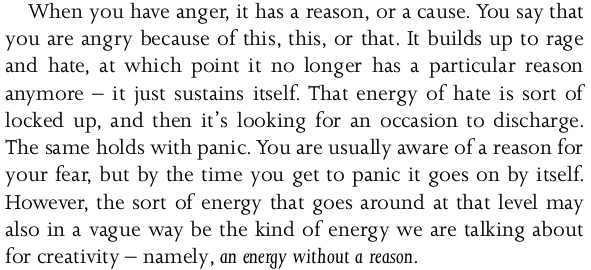
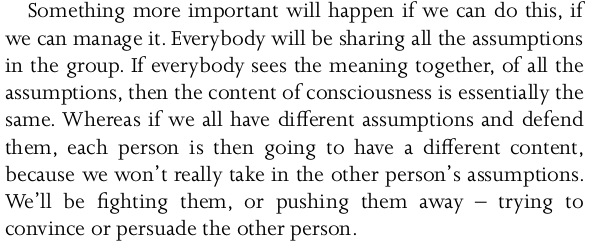
A couple excerpts from p39 of On Dialogue, on how it is that we come to the impression that our assumptions need defending.
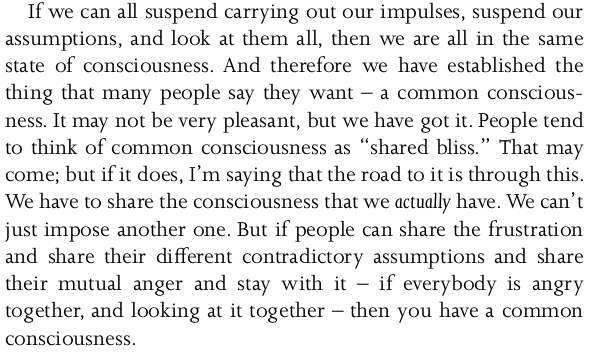
p38. Scrolling up while posting 🙃 > if people can share the frustration and share their different contradictory assumptions and share their mutual anger and stay with it – if everybody is angry together, and looking at it together – then you have a common consciousness.
> Conviction & persuasion are not called for in a dialogue. > There’s no point in being persuaded or convinced. That’s not really coherent or rational. If something's right, you don’t need to be persuaded. If they have to persuade you, then there's probably some doubt about it.
Seems apropos to link this in here. It also seems very clear to me that Bohm is an early metamodernist (this was written in the 90s and specifically decries relativism etc)
Bohm is clearly tapping the same vein as McGilchrist here, and uses the same etymological breakdown of "Re-presentation". Light excerpts Bohm, dark excerpts McGilchrist.
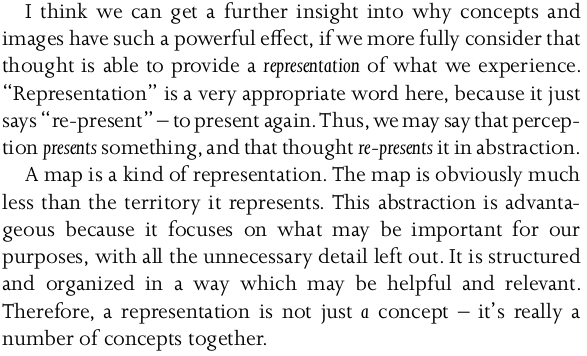
Bohm has some really great stuff to say about how the left hemisphere (or as he calls it ~"thought that doesn't know that it's part of a thinking process that's having an impact on what it is they're perceiving") creates blindspots. I'd reco this book for
I'm sure I'll tweet out a lot more from On Dialogue, as I'm loving almost every paragraph and I want to read it again. Figured for now I'd just throw out a bunch of stuff that excites me! (@utotranslucence I'd love to read this out loud on Relational Exegesis!)