I think there's WAY more design work to be done for common knowledge creation in our apps. Gonna ideate in this thread and see what I come up with.
Designing apps for common knowledge and shared media context
10 tweets · May 2020 · 39 likes · 2 retweets · read on Twitter

Twitter already does a thing where it shows you "Fred liked this", but it doesn't go back and tell Fred that you then liked it. Even if it did, it would still need to tell *you* that it told Fred, then it would need to tell Fred that it told you that... ∞
Exhausting. But what if you could make some sort of team (or pair) and then within that team it would periodically notify you in some sort of simultaneous way "you guys all liked/retweeted this!" such that the whole team would know that the whole team got the notification.
I've been thinking about this in relation to shared media consumption & its role in context setting for a team. We have a #media channel on our slack where we post links, and there's generally a rough assumption that everyone in the core team is caught up to the last few days.
At one point I tried to systematize this a bit with a spreadsheet where one axis was people and the other was media items, and people could then check off when they'd read/listenedto something, and what they thought of it. Could be used to generate a list of common readings.
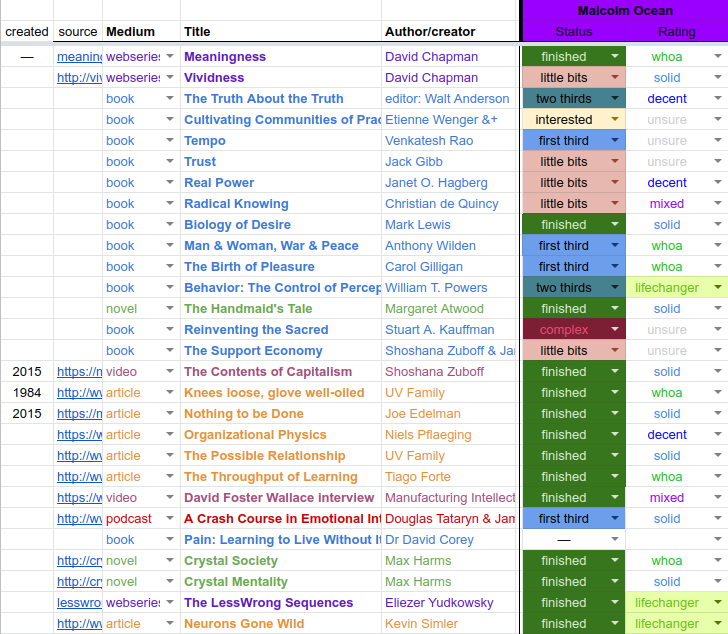
Super hard to scale stuff like this though... upwards of N² complexity, maybe even N! depending on what you're trying to do with it. (I don't understand this in-depth but it's part of why music recommendations based on common listening still aren't yet blowing all of our minds.)
@utotranslucence's Relational Exegesis zoom events produce a similar powerful effect somehow, by having people read a book aloud together & comment on it. Rich convos afterwards, from a common meaningspace created by the collective.
Having people read aloud & comment on a google doc together live dramatically increased the sense of the others BEING THERE. Contrast with a call where a speaker presents then people discuss. Conceptually we know we heard the same content, but you don't feel it in the same way.
(There are other issues w speaker presentations too, in that they tend to invoke Q&A and thanking dynamics etc, rather than people connecting deeply 1-on-1 & in small groups. Weird authority stuff, that was actually topic of 1st Relational Exegesis event)
Anyway, I don't feel like I have good answers but I'm seeing ways in which truly-common knowledge (on various scales) is a profoundly scarce resource atm and I think whatever companies figure out how to generate & organize it will make a lot of value & maybe even a lot of money.