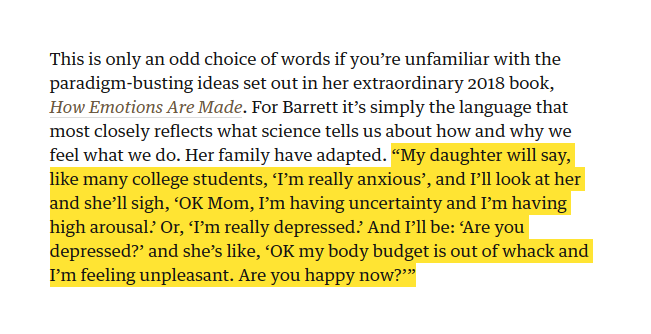
Had heard about @LFeldmanBarrett's work before; this article piqued my interest on a different level hearing how's affected her own speech: > instead of saying “I’m scared,” she blurted out: “I’m experiencing high arousal from uncertainty.” theguardian.com/books/2020/sep…
Culturally constructed emotions and inventing new emotional language
15 tweets · October 2020 · 106 likes · 2 retweets · read on Twitter
This assessment—that emotions are culturally constructed—seems to have a sort of trivially true meaning, which I think I'd already integrated. It also implies something much bolder: the capacity to consciously construct entirely new emotions as part of culture change 😮
This is, as I see it, part of what Barrett is doing in the excerpt quoted above. This could seem like just deconstruction, which is also accurate, but I think it's still constructive, because by using the phrase "high arousal from uncertainty", in the moment, it gains meaning.
On a different level, I think the modern meme environment does this unconsciously already, just... less verbally. But having a specific image/gif/emoji handle for a feeling *is* different than just having associated gestures. I think sometimes I *feel* nathan_fillion.gif

This is like how sign language differs from pantomime—the former has actual signs, with precise shared meanings. It's symbolic, rather than directly trying to evoke something. The gif itself kind of does both, but "nathan_fillion.gif" is a sign (to those in the know).
There's a lot of richness in the historical feelings, and I think it's really important not to disown the meaning that they hold. I discovered when I learned Bio-Emotive from @DougTataryn that I had repressed all sorts of feelings that consciously I thought didn't make sense.
This included feelings where I had reasons for saying they didn't make sense (such as "shame" or "worthlessness") as well as just feelings where implicitly I was constructing my life in ways seemingly incompatible with those feelings (such as "sadness" or "panic")
When I've facilitated the Bio-Emotive NEDERA process for ppl who grew up speaking a different language, they've often found phrases that don't resonate nearly as much in English as they do in the natural language of their younger selves whose memories they're working with.
This is entirely compatible with Barrett's top-level claim that emotions are culturally constructed—in fact it supports it greatly—but it suggests to me that we might want to take great care when deliberately reframing our emotions. Meanings are sacred, &
This has me a bit concerned about the account of how Barrett is working with her daughter in this excerpt from the article. The sigh and the "are you happy?" reveal a tension from attempted overwriting. (This still seems better than most parenting, tho that's not saying much.)
For reframes that support integrity, try on the new phrasing gently: "Hmm, I feel uncertainty & high arousal" Allow yourself to say "No, I feel ANXIOUS!" You don't get to tell others how they feel or what it's okay to feel. Your intellect doesn't get to tell *you* how you feel.
Neuroplasticity is a thing—the brain can change, and retain changes. So I'm bullish (is that a feeling? hm🤔) about reculturing with a better feeling-toolkit. A feelkit. I think that's both worthwhile & possible. *And* it requires upgrading the existing one, not overwriting it.
In this case, that means bringing your old words & meanings into dialogue with new concepts, whether those are the neuroscience concepts that Barrett promotes, or concepts from something like Buddhism. And both have lots to offer, which is exciting!
eg I've been reading Spectrum of Ecstasy: The Five Wisdom Emotions of Vajrayana Buddhism, and it is pointing at how certain contracted feelings are clouded expressions of certain expansive feelings, eg anger & clarity. Learning this ontology requires *feeling* its truth.
And in the meantime, and always, it is okay to feel exactly how you feel right now, and to name that feeling however it wants to be named.