I really don't like when authors say "any wisdom herein is from [my teachers], any mistakes are my own". I think I see what it's trying to do and I think we can do better. I'm not totally sure how but I have some ideas. Thread 🧵👇
Rethinking 'any mistakes are my own' acknowledgements
11 tweets · September 2020 · 71 likes · 4 retweets · read on Twitter
I get that it's intending to honor the wisdom of one's teachers and not make them responsible for ones' mistakes. But I think we can do that 𝘸𝘪𝘵𝘩𝘰𝘶𝘵: 📉 implying the entire enterprise of knowledge is always lossy 🤦♀️ over-humbling oneself 🤩 pedestalizing one's teachers
What might that look like? I'm interested in your thoughts. Newton's "if I have seen further it is by standing on the shoulders of Giants" is one approach I like. Honoring both ones' forerunners stature as well as… ones' own… uhhh… capacity to balance on someone's shoulders.

I might write… "I have learned so much from [specific/general teachers]. I could not have even begun to approach this topic without them. I also wouldn't've written this if I didn't think I had something to add. My teachers are not responsible for my errors, nor my wisdom!"
That sounds weirdly formal, but so does… "If there is any value to be found in this book, it is entirely due to the inspiration of [teachers]. Any faults are entirely due to our own inadequacies." …which is on the dedication page of a dharma book I'm reading & loving atm.
That phrasing seems to be essentially saying "my teachers get all of the credit and none of the blame", which is a beneficent gesture but still instantiates blame as an appropriate kind of explanation. (Blame is, as far as I can tell, incompatible with the dharma.)
Reflecting further on my phrasing: > My teachers are not responsible for my errors, nor my wisdom. The perspective of mutual causality (or "dependent co-arising" in buddhist lingo) says that this division is nearly as bizarre as "they get all the credit & none of the blame"
My teachers 𝘢𝘳𝘦 partially responsible for my wisdom & errors. This is true in the obvious ways: to a large extent, I learned what they taught, both wise & erroneous.
This is also true in non-obvious ways: Some of my errors may come from things my teachers understood so well they took for granted & forgot to explicate. Some of my wisdom may come from my teachers' confusions or blindspots—necessitating my inventing a way to make sense of that!
Ha! Okay, a snarky flamboyant take: "My teachers were brilliant & wise, otherwise they would not have have had anything to teach. My teachers were also fools who couldn't see what I now see. I am also a brilliant fool. Your job, dear reader, is to be your own brilliant fool.🙃"
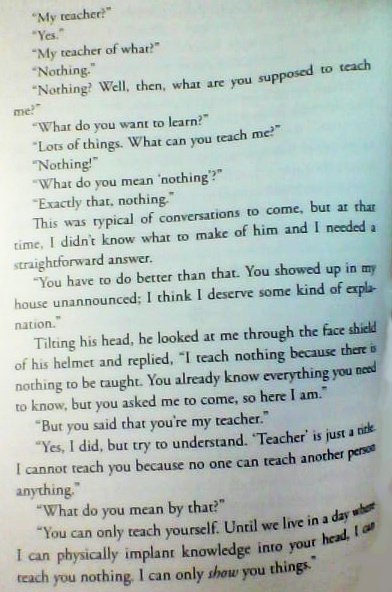
Also, in all of this, worth dissolving your concept of whether the role of "teachers" is teaching. Wooten says it best: "I teach nothing because there is nothing to be taught." "But you said that you're my teacher." "'Teacher' is just a title..."