McGilchrist's brain hemisphere model 🧠 + buddhist concept of impermanence ⚱️ thread! (CC @_awbery_, @Meaningness)
McGilchrist's brain hemispheres and Buddhist impermanence
8 tweets · January 2020 · 55 likes · 5 retweets · read on Twitter
The left hemisphere (which if you read McGilchrist you'll see is responsible for most of what is often called "ego" etc) orients to the world as being largely static, or dynamic in some manipulable way. Also fixed, separate, categorizable things.
The right hemisphere (which is responsible for much of spiritual experience, or even experience of *meaning*) orients to the world as being dynamic, process-based, etc. Also a basic non-dual (though not monist) stance. See also many Heraclitus quotes.
Both of these 👆 perspectives have truth (ie map-territory correspondence) Yet: "everything changes but we can usefully pretend some things don't" seems more true than the reverse. (Similarly "everything is interconnected but we can usefully pretend things are separate")
These useful oversimplifications are, in large part, what the left hemisphere is *for*; they are necessary for being able to usefully count things, plan, talk about anything (before it's gone) etc. However, fixated as true, they are illusion & confusion.
So it seems like the shift from the left hemisphere's perspective being primary to the right hemisphere's perspective being primary is core to the shift that recognizes impermanence and the other buddhist structures. The implications of this...
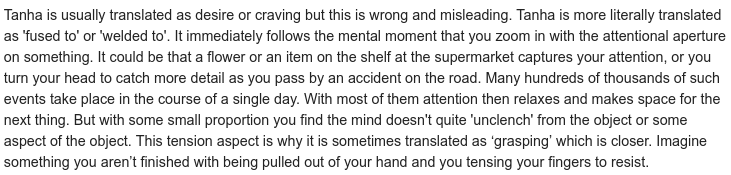
eg "Tanha", usually translated as "desire" or "craving", is described below left (by Romeo Stevens) as "zooming in" or "grasping". Lo: these are left-hemisphere moves!
For more connections between brain hemispheres & buddhism, check out this thread 👇 I am hardly an expert on either subject, but I seriously think that for people orienting towards awakening, McGilchrist is one of the most valuable resources for View 👁️👁️
