Matt's talking about coherence therapy here, kind of in relation to addiction/trauma, as I understand it. I want to start by thanking him for being my "someone wrong on the internet" today and motivating me to write up this thread ❣️
Why parts are never unreasonable, only differently framed
16 tweets · October 2020 · 81 likes · 1 retweets · read on Twitter
> recognizing that the parts are being unreasonable Fascinating. A vital tenet of the epic meta-system I've been developing for the last few months is something like "parts are NEVER unreasonable". And this seems core to Coherence Therapy to me.
Saying "unreasonable" seems to me to assert a kind of dominance, of the experience+frame of whoever's saying it, which makes it harder to see what's going on for the part! (I keep wanting to use the term "hegemonic" here. Or "privileging the frame h̵y̵p̵o̵t̵h̵e̵s̵i̵s̵")
Every part is acting 100% reasonably, within its frame. Its frame may be, in some sense, narrow or irrelevant or confused—and it's important to notice if you think so—but good luck having a dialogue with any entity whose frame you disrespect.
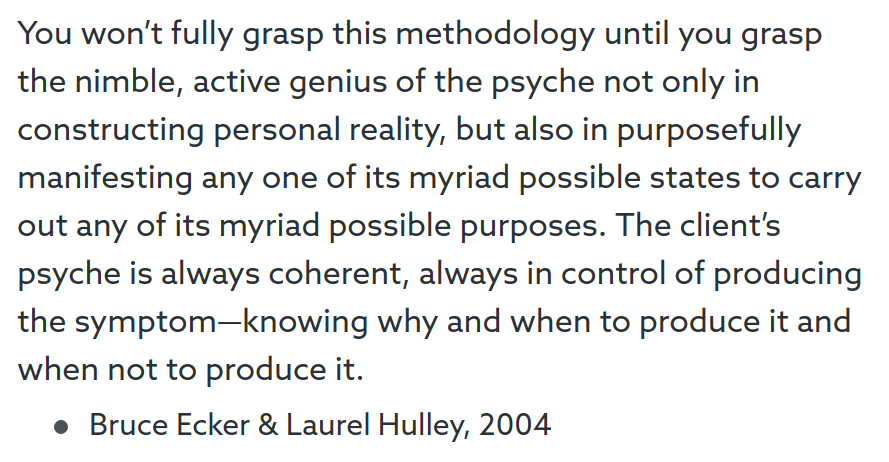
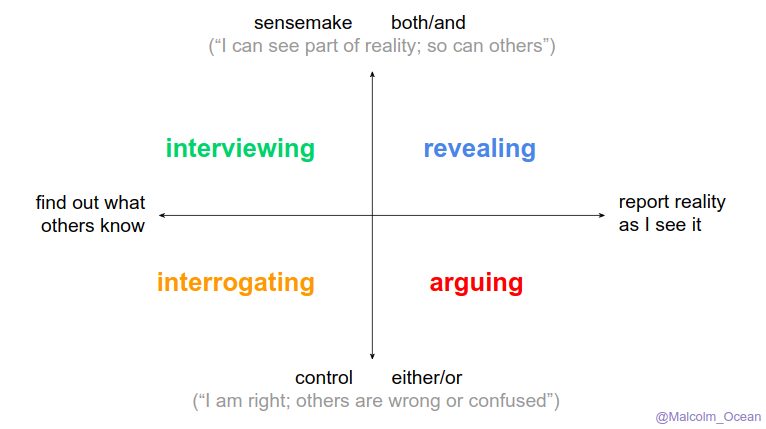
And a core finding of memory reconsolidation is that arguing with your parts Does. Not. Work. Well, doesn't work for integration. It can effectively suppress some knowing—you can get appearance of consensus by shocking whoever pushes the veto button.
So dialogue is necessary—whether verbal or not. (By "dialogue" I'm referring to a kind of stance that's the opposite of arguing, where you neither privilege your own frame, nor simply surrender it either. Kind of the top half of this 2×2.)
In original context, @mattgoldenberg says "not all parts can be reasoned with". In narrow sense of the word "reason", I think some parts are "un-reason-able". But their stubbornness is actually deeply sensible, as opposed to being made out of unreason.
"Unreasonable", perhaps, in practice, means "refuses to talk with me how I want to be talked with". In this sense, from the unreasonable part's perspective, you're also being unreasonable! So the puzzle, w/ parts or ppl, is to find a way to dialogue that satisfies BOTH parties.
Agents have a tendency to try to drag other agents into their own frame in order to have conversations, because there's a huge home turf advantage. Meanwhile, agents also resist such drags for the same reason! This, on all fractal scales:
To some extent, I'm even doing that here! Look at me defining "unreasonable" in this uncharitable way. Am I really trying to dialogue with Matt, or score points or something? 🤔😂🙃
Fwiw, I myself held the very confusion I'm trying to illuminate here, til about 4mo ago. So this is in some ways me trying to point something out to past me and people in a similar situation. I'm not sure this thread would have worked for that! But might help someone. Lmk.
So yeah: any person, or part, that thinks other parts are being unreasonable is also a part and (within its frame) is being totally reasonable in holding it that way. So one can't simply decide to not see it that way. As always, must integrate the purpose of seeing it that way.
Personally, I've worked with a few resistances to this idea, including helpless rage when people like @reasonisfun would say things like "all behavior has reasons". One associated w traumatic pseudomemory of my pain getting dismissed bc other person's behavior must have reason 😬
For me, thinking about it in terms of "coherence" rather than "reason" helped tons. Sounded less like justification? Maybe just didn't trigger the association. Who knows. Anyway, turns out the coherence underlying apparent dysfunction is actually deeply reassuring to me.
So find what works for you 🥰 Will probably start with getting a sense of the meaning & integrity of all of your own behavior, via eg Core Transformation. Then generalize. You'll know you've hit on the same kinda thing if it has this sort of effect:
Helping my own parts see this (and integrate it with their existing knowings) and helping other people see this (and learn from them how my own frame is yet too narrow) is one of my top priorities at the moment 🤩🚀 Another: (on a diff abstraction level)