Note the difference between: • "wanting to not cry" • "not wanting to cry" You can want to cry AND want to not cry. That's actually very common (about crying but more generally too).
Wanting to not X versus not wanting X
10 tweets · November 2021 · 49 likes · 1 retweets · read on Twitter
In the case quoted above, since I broke it into "part of me", it would still be *true* to say "part of me doesn't want to cry" but that's a weaker statement. Most parts of you don't want most things, but they're not *blocking* those things. If it's blocking, it's a want-not.
If you simply want to cry, you cry. If you feel the need to say "I want to cry" because you're not crying, it's because part of you is blocking the crying. Its reasons may be circumstantial or general, shallow or deep. But it is saying "not that".
Absence is different from negation. People are kinda bad at using words tho. This is possibly for euphemistic reasons, eg "I don't know if that's a good idea" sounds softer than "I actively think that's a bad idea".
@RomeoStevens76 pointed out something similar he calls the Korzybski Gap. He was pointing at the other direction (negative knowledge to positive knowledge-not instead of positive desire-not to negative desire) but it's fundamentally the same confusion.
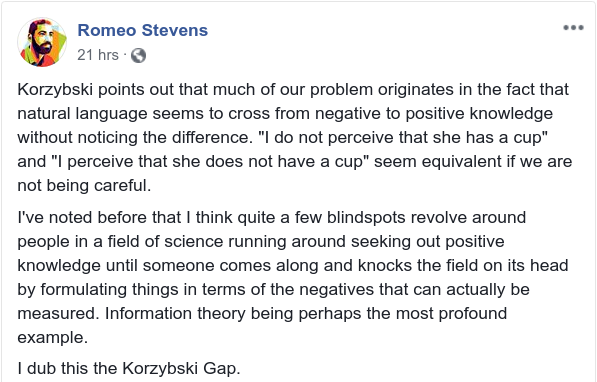
Whenever I think about this stuff I think of this tweet/thread by @QiaochuYuan. This is really an example of "Few understand this." I bet he and I don't even really grok the significance of it. Something really deep here.
Going back to parts & wholes... remember this classic joke? Three logicians walk into a bar. The barman says, "Does everyone here want a drink?" 🍻 The first logician says, 'I don't know.' The second logician says, 'I don't know.' What does the third logician say?
"You want X" + "I want not-X" implies ↳ "We don't want X" ↳ "We don't want not-X" ↳ "We don't know what we want" Here absence of want (& knowledge) arises from conflict. ("we" here = [the system of the both of us], not [the set of individuals])
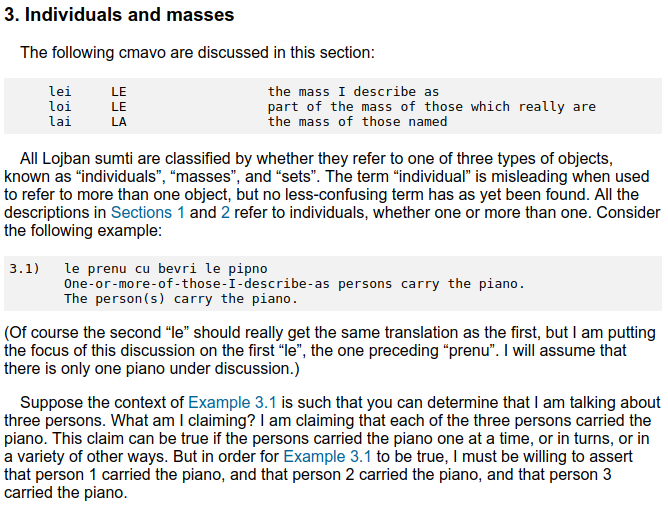
In practice You want X because it gets you Y I want not-X because it gets me Z ...and so what we want is Y+Z. This is what we're talking about when we talk about finding win-wins when starting from a place of conflict.
This also applies fractally internally: if part of you wants something and part of you wants to not have that, it's not per se the case that you, speaking on behalf of the whole, can truly say "I want that". I talk about this differentiation here: malcolmocean.com/2021/08/intern…