Everyone's basically living in a dream mashup of their current external situation & their old emotional meanings. Like dreaming you're at high school but it's also on a boat somehow. & as in dreams, somehow the weirdness of this mashup goes unnoticed malcolmocean.com/2021/06/dream-…
Living in a dream mashup of present reality and old emotional meanings
33 tweets · June 2021 · 670 likes · 60 retweets · read on Twitter
Not only does the weirdness of the mashup go unnoticed while you're dreaming, you sometimes don't even realize how weird it is after waking until you actually stop & think about it. And then you’re just as fooled by the next dream, until you wake up again.
The emotional brain is experiencing something totally real—just as your high school is real. The part of you that’s taking in reality is experiencing something totally real—just as boats are real. But there is no real “my high school, except on an boat”.
People experience these mashups in relationships as well, emotionally experiencing their friends & partners as if they’re a parent, teacher, sibling, or bully from childhood, or an earlier friend or partner. Or, as adults, they project authority on their parents they had as kid.
Pete outlines over a dozen creative responses to the flashbacks, most of which are transformational and a few are counteractive. Using some counteractive approaches alongside transformational ones can produce short-term empowerment that fuels further transformation.
What do I mean by counteractive & transformational? The distinction comes from Unlocking the Emotional Brain, an excellent book you can read an excellent summary of here: lesswrong.com/posts/i9xyZBS3…
Counteractive approaches to behavior change are based on trying to train/convince oneself to do X instead of Y. Ok for simple mechanical habits but for anything emotion-based requires ongoing maintenance to perform some new consciously-desired behavior in spite of one's urges.
Transformational approaches are based on understanding what’s generating the behavior in the first place—how it’s understanding the situation such that it’s doing what it’s doing and it makes total sense to do that thing. Then the part doing X can *see* if Y makes more sense.
What to do if you notice you’re dreaming? As anyone who’s tried to lucid dream can attest, noticing you’re dreaming is at least half the battle in the first place! Emotional untangling techniques like Bio-Emotive can make the move more accessible, internally AND culturally.
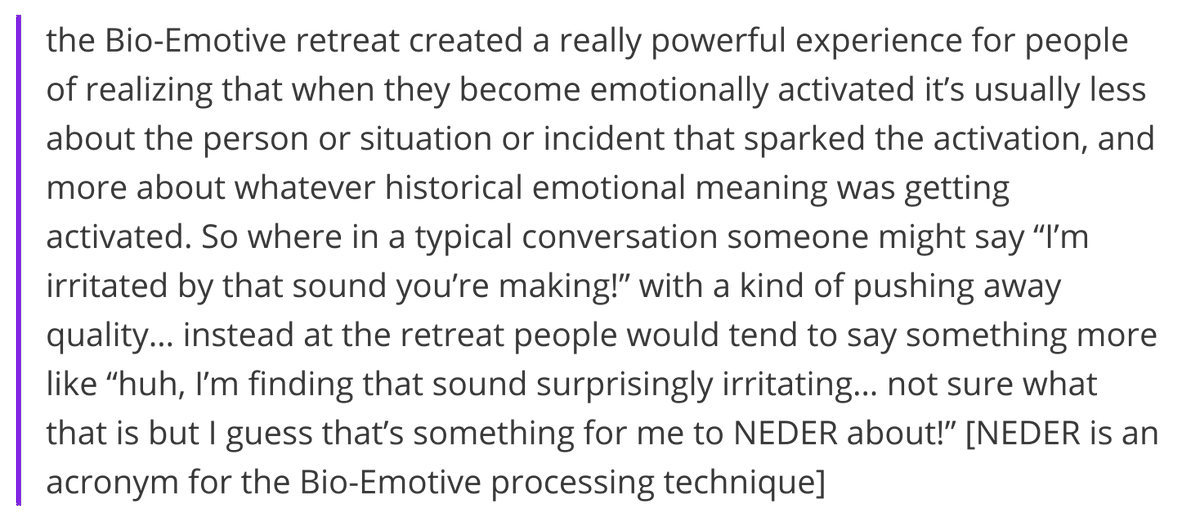
Here's a way I like to go about disentangling two key dimensions of things. If I'm on my game I can notice I'm having a strong emotional response to a situation that doesn't directly threaten me, and get curious and maybe reveal "I'm activated/projecting"
What to do if you notice someone else is dreaming? I used to think it was the job of the person having the flashback, to notice & pull themselves out. That’s great when it works, but as I’ve mentioned, it’s really hard to notice.
I also used to think that if I noticed someone else was in a flashback, the thing for me to do is to point it out to them and try to get them to wake up. Sometimes this works but in my experience it tends to backfire because it’s an attempt at controlling them.
It works better if I’m able to respect the intelligence of the other person’s emotional cognition. Rather than saying “wake up — be present with me”, acknowledging that on some level they genuinely are having trouble telling me apart from someone who has (and would) hurt them.
Then I try to take on a playful improvisational stance that asks “how can I become an invalid target for whatever they’re projecting on me?” I might fail, but the important thing is I'm actually trying to give them new data to grok as opposed to demanding they reinterpret.
As I said above, the size and shape of an emotional response has more to do with the person's history than the particulars of the situation, but all the same, *something* in what I was doing resulted in them having had that response, in that moment, not a different one.
In general, creating safety for everybody is the aim—and if creating safety for the other person feels threatening or like it would make me unworkably vulnerable, I need to start by creating safety for myself.
Someone close to you going into a flashback sucks. It feels disconnecting. That's natural and you don't have to like it. I've noticed there's a difference between the intrinsic disconnect though vs my own attachment fears being triggered. If so, any "wake up" comes from panic!
Instead of trying to wake the other person up, soothe yourself and affirm your own experience of not liking what's happening.
(Man. I try to write these posts/threads in first person perspective about how I approach things but it's so easy to lapse back into imperative case. Probably partially because using "one" in English is awkward, so one ends up with general-you, and then from there into advice.)
Btw, what's happening here isn't a biological flaw. It's the brain working effectively to rapidly generate a model of what's going on and what to do about it. Same hardware that lets you "pick up like it was just yesterday" when you meet an old friend you haven't seen in years.
Also the same cognitive process that allows a firefighter to rapidly recognize something suspicious about the temperature of the house he's in and get his team to safety before the floor collapses—a specific case study from this book:
In the original tweet Qiaochu wrote that I responded to with the dream mashup metaphor, he's talking about not just strong acute trigger moments but ongoing worldviews. Dream mashups are basically the default mode!
The only reason they even seem bizarre is that the generalizations tend to get stuck. And it's not just big-t Trauma from abuse! Even if you had a pretty good childhood, there's still lots of learnings that you inevitably picked up that were true then but aren't as an adult:

And, unless you were homeschooled by incredibly integrated parents, or enrolled in an excellent Montessori school or something, you probably also picked up some learnings like these: (plus others from avoiding your peers making fun of you)

These learnings aren’t made out of words; they’re an embodied sense of the way the world is. But, we might ask, why don’t people immediately unlearn these generalizations as soon as they’re no longer relevant?
Shame, mostly—in part due to some of these very learnings. Untangling these learnings requires curiously exploring what they are & how they got there, which requires acknowledging that you don’t actually know why you’re doing what you’re doing. …Hard when ppl want u to justify.
Another stuckness factor is that whether shame or fear or sadness, most people learn in childhood that there are a lot of feelings it’s not safe to feel. The feelings themselves come to feel threatening, if expressing them means freaking out our parents.
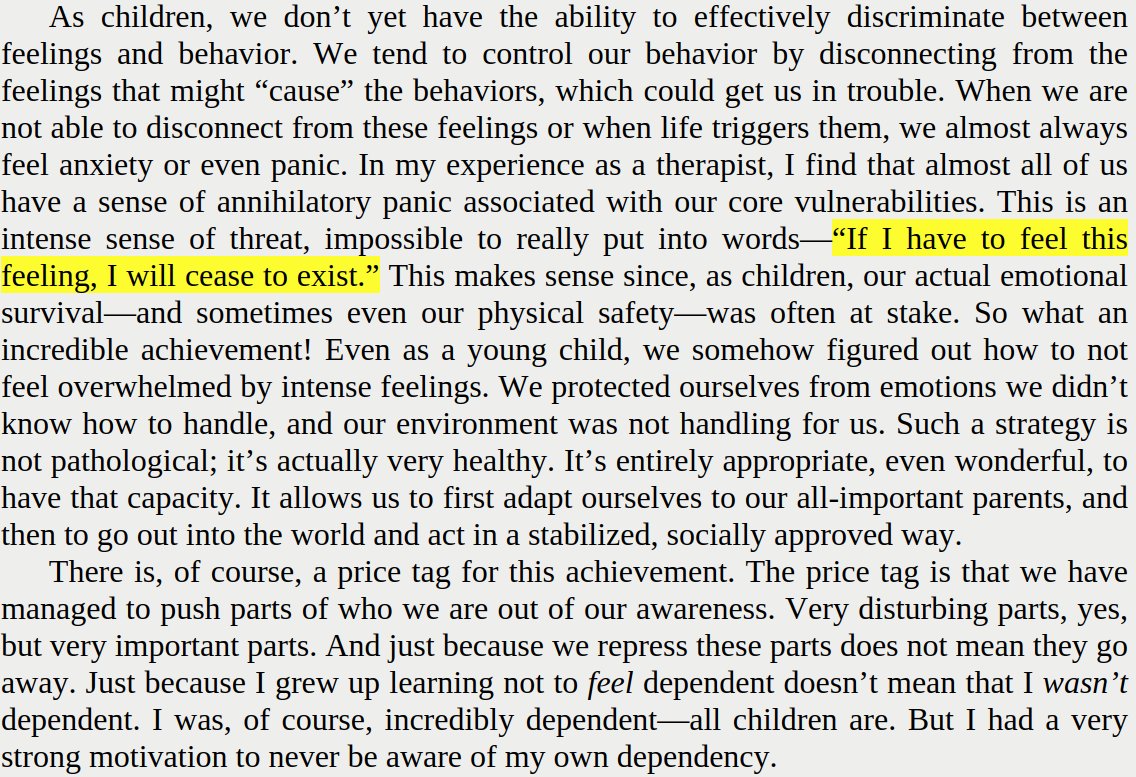
So we block ourselves from seeing the remarkable sensibleness of these unconscious perspectives when assessed on their own terms, a seeing which can then enable us to see a new sense we can make of the situation.
Instead, we have the impression that we are simply being irrational and should snap out of it. These are deep confusions; waking up from them *ongoingly* requires a thorough reorganization of our thinking, not just a jolt into presence (which may help for a moment).
We are, collectively, just starting to realize what’s going on, and to thereby wake up from the collective dream of cultural memes from humanity’s adolescence that are becoming an increasingly inappropriate and bizarre mashup when overlaid on our current actual global situation.
> We're living in the midst of not only a scientific revolution in our understanding of trauma & a clinical rev'n in our ability to treat it but also a cultural rev'n in our awareness & acceptance of trauma as a normal part of human experience. @fortelabs fortelabs.co/blog/groundbre…
Okay that is literally an entire blog post as a tweetstorm. Some sentences omitted and the original is probably clearer, but if you read the whole thing you should have the gist. Still, if you want to share a single link, this is your guy: malcolmocean.com/2021/06/dream-…